
Do you like watching dogs dump? Not something I do reallyWatching 360 is like staring at a dog taking a dump. In both cases your watching shit coming out of an dog out in real time hahahaha


 www.foxsports.com.au


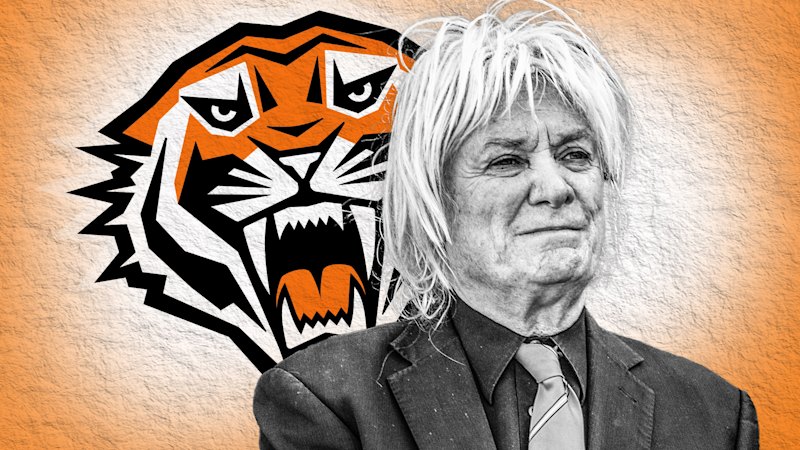
They have no shame.It’s been dubbed ‘the most chaotic board in NSW’. But Wests Tigers’ owners are pushing for a pay rise
By Chris Barrett
March 7, 2026 — 4.21pm
Wests Tigers’ owners are bidding to give themselves a pay rise three months after a shambolic episode in which they sacked chairman Barry O’Farrell and three other directors before backflipping at the behest of the NRL.
The Holman Barnes Group, which owns 90 per cent of the Tigers and holds the licence for the NRL team, has for the past year been embroiled in turmoil that has threatened to spill over into the football club.
Now, its board members are seeking a boost which would see them collect more than their counterparts at most other Sydney clubs with ties to NRL teams.
HBG is proposing that its chairman’s annual honorarium be lifted from $51,341 to $65,000, the deputy chair’s fee to be raised from $33,371 to $50,000, and all other directors to get $32,500 instead of $25,670. All would also receive an extra $5000 if they sit on a club committee.
The effective $70,000 payment per annum for the chairman would eclipse the amounts paid to those in charge at most of Sydney’s major NRL-affiliated leagues clubs, including those with much larger membership bases.
Parramatta Leagues Club, which owns the Eels and has 65,000 members, gives its president $30,000 a year and other directors $20,000.
The 60,000-member Canterbury League Club, which is strongly linked to the Bulldogs and backs them financially, allows for a total of $229,801 to be paid to its seven directors including the chairman – an average of $32,828, although the chair and deputy chair receive a greater share.
St George Leagues Club, which owns 50 per cent of the Dragons and has 25,000 members, hands its chair $16,000 a year and ordinary directors $12,000, plus $2000 for each committee they sit on.
HBG has 27,000 members and the proposed honoraria for its board are exceeded only by those at Penrith NRL team owners Panthers Group, where total revenue was nearly $180 million in 2025 and which has a membership base of 148,000. The Panthers’ chairman receives $80,000 a year, its two deputies get $40,000 each and the remaining directors pick up $20,000 per annum.
Like those at other clubs, the HBG board members can take advantage of other perks of the position such as food and drinks. At the club’s annual general meeting on March 21 members will also be asked to approve its chairman and deputy receiving $500 per month hospitality cards.
“As Holman Barnes Group’s business has expanded, the workload and governance responsibilities placed on directors have increased substantially,” said HBG vice-chairman Frank Primerano, who also sits on the Wests Tigers board.
“The proposed adjustments simply bring board honorariums into line with the scale of the organisation and the time commitment required, particularly as directors are increasingly involved in committees and strategic projects during this period of significant growth and investment.”
A source familiar with the activities of HBG, speaking on the condition of anonymity, said: “How can the most chaotic board in NSW simultaneously become one of the highest paid?
“If the stipend for the board were based on performance then quite obviously these people would be getting a pay cut, not a pay day.”
HBG, which oversees venues including Wests Ashfield, returned a net profit of $11.9 million in 2025 after raking in $52 million from poker machines and recording overall revenue of $100 million, according to its annual report.
But the organisation has been plagued by dysfunction during the past 18 months, with several board members controversially removed and former NSW premier O’Farrell and three other independent directors then sensationally axed from the Tigers last December less than a year after they were installed following a governance review.
After concerns were raised by the NRL, HBG reinstated them days later and O’Farrell was Tigers chairman. But the club was forced into a costly payout to Tigers chief executive Shane Richardson, who resigned amid the boardroom chaos 18 months into a four-year contract, and settled out of court with former HBG director Rick Wayde, a key instigator of the Tigers review, after he was banned for eight years.
HBG, which owns the NRL team via its control of Wests Magpies, has since beefed up its representation on the Tigers board, giving it an effective majority.
While the Tigers are governed separately to their owners, NRL funding for the team flows through HBG.
According to its latest financial report, HBG received $20 million from the NRL in 2025 and owes $36 million to players and head coach Benji Marshall over the next five years.
HBG is unusual in that the balance of power lies with 20 so-called debenture holders, who choose the majority of its directors under a decades-old, undemocratic system.
Only two of nine board seats are directly elected by the wider membership and there will not be a ballot for those spots at this month’s AGM after one of the three nominations withdrew.
The two remaining are well known to HBG board members: Shannon Cavanagh, a director of Wests Magpies alongside HBG chairman Dennis Burgess and Primerano, and Aldo Di Mento, a director of APIA Leichardt FC – the inner-west soccer team in which HGB bought a stake last year and on whose board Primerano and HBG chief executive Daniel Paton also sit.
It’s been dubbed ‘the most chaotic board in NSW’. But Wests Tigers’ owners are pushing for a pay rise
Three months after sacking four club directors then backflipping at the behest of the NRL, Holman Barnes Group is proposing to increase payments to its board members.www.smh.com.au


HBG is proposing that its chairman’s annual honorarium be lifted from $51,341 to $65,000, the deputy chair’s fee to be raised from $33,371 to $50,000, and all other directors to get $32,500 instead of $25,670. All would also receive an extra $5000 if they sit on a club committee.
So True, why do you have to make sense of everything Tiger and spoil a good wingeThe pay rate for the job is a pittance though. I honestly don't see the big issue.
Seriously is this something to get worked up about ???
To me it's just click bait BS.


Not an Aussie to be seenSixty-six heritages, one game: How Tigers are embracing Multicultural Round
By Adrian Proszenko
March 18, 2026 — 5.00am
The England Test coach, as soon as one is appointed, should take note: Alex Seyfarth qualifies for your Rugby League World Cup squad.
“My mum was born in Bradford in England, she came over here when she was 14 years old,” Seyfarth said.
But that’s just the beginning of Seyfarth’s ancestral story. The West Tigers forward’s maternal grandfather, Edward, is of Sri Lankan heritage.
“When you see a photo of him, you’ll laugh, it looks like Bob Marley,” Seyfarth said. “He wears Bob Marley T-shirts.”
His father, meanwhile, has Slovenian roots.
“My grandfather on the other side, my dad’s side, he was here in 1932, he came over on a boat,” Seyfarth said. “I didn’t get to have as many conversations around what life was like over here. He’s come over here and he’s just worked up until the age of his mid-80s when he passed.
“He was a bricklayer. I’m a third-generation bricklayer with my old man. I was a bricklayer by trade before I went full-time NRL.”
Seyfarth is sharing his heritage story as part of the NRL’s multicultural round celebrations. There are hundreds like it: players with familial links to far-flung destinations including Russia, Iran, Rwanda, Japan and Norway. There are 66 national heritages represented across the NRL and NRLW squads, while 27 per cent of NRL players were born outside Australia.
Over half the NRL players have a father born overseas (57 per cent), while 47 per cent have a mother born overseas.
The NRL is in an expansionist phase. The game has been taken to new frontiers, as evidenced by its decision to open the season in Las Vegas. At the same time, there’s a nod to its Pasifika heritage, whether it be via the promotion of more Test football or the introduction of PNG into the competition from 2028.
Like all clubs, the Tigers have players from a range of backgrounds. Their cultures are celebrated with flags on their lockers showing which countries their family is from.
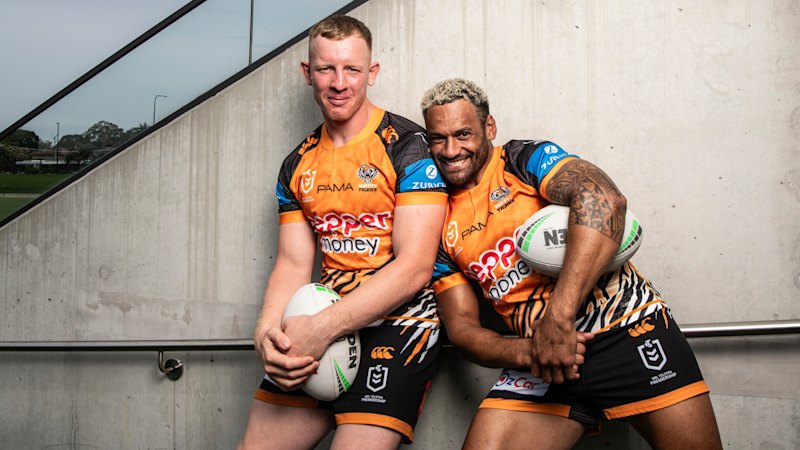
“I don’t think I’ve been a part of a team that’s been so mixed, culturally. It just mixes so well together,” said Tigers co-captain Apisai Koroisau, who posed alongside Seyfarth in the club’s multicultural round jerseys.
“The personalities of the guys here are all just so laidback, they can all just make fun of each other so much. You get to know each other off and on the field.”
There are further statistics that tell the NRL’s multicultural tale. Almost a quarter (23 per cent) of NRL players have a father born in the Pacific Islands, while 18 per cent have a mother born in the Pacific Islands. Over two-thirds (68 per cent) of NRL players have at least one grandparent born outside Australia. And 12 per cent of NRL players identify as Aboriginal and Torres Strait Islander, while 10 per cent are of Māori descent.
Seyfarth believes his work ethic was instilled by his parents and grandparents.
“My mum coming over when she was young, she worked three jobs raising us, me and my brother,” Seyfarth said. “Always watching them, working hard all my life, it sort of flowed onto me.”
Which is why Seyfarth would love to honour his English heritage by pulling on the white jersey in this year’s Rugby League World Cup.
“If I can play some good football and put my name in the ring and get a chance to tour with them, that’d be awesome, representing that side of my family,” he said. “It would mean the world, especially with my grandfather too, he’s a very proud Englishman.
“Same with my mum. They came out here just for a better life at the time, and they’re still always wanting to get back to get back there whenever they can. If I do ever get the opportunity, yeah, I’ll be extremely proud to put the jersey on.”
NRL player representation by continent
Africa
Burundi
Egypt
Rwanda
South Africa
Tanzania
Zimbabwe
Asia
China
Hong Kong
India
Iran
Japan
Jordan
Lebanon
Malaysia
Pakistan
Philippines
Singapore
Sri Lanka
Timor-Leste
Europe
Austria
Croatia
Cyprus
Denmark
England
Finland
France
Germany
Greece
Hungary
Ireland
Italy
Latvia
Malta
Netherlands
Norway
Poland
Portugal
Russia
Scotland
Serbia
Slovenia
Spain
Switzerland
Turkey
Ukraine
Wales
North America
Antigua & Barbuda
Canada
Cuba
Jamaica
Saint Vincent & The Grenadines
Trinidad & Tobago
USA
Oceania
American Samoa
Australia
Cook Islands
Fiji
New Zealand
Niue
Papua New Guinea
Samoa
Tokelau Islands
Tonga
South America
Brazil
Chile
Sixty-six heritages, one game: How Tigers are embracing Multicultural Round
There are hundreds of fascinating player heritage stories across the NRL. As the game celebrates Multicultural Round, a Tigers forward shares his.

They missed Queensland.Sixty-six heritages, one game: How Tigers are embracing Multicultural Round
By Adrian Proszenko
March 18, 2026 — 5.00am
The England Test coach, as soon as one is appointed, should take note: Alex Seyfarth qualifies for your Rugby League World Cup squad.
“My mum was born in Bradford in England, she came over here when she was 14 years old,” Seyfarth said.
But that’s just the beginning of Seyfarth’s ancestral story. The West Tigers forward’s maternal grandfather, Edward, is of Sri Lankan heritage.
“When you see a photo of him, you’ll laugh, it looks like Bob Marley,” Seyfarth said. “He wears Bob Marley T-shirts.”
His father, meanwhile, has Slovenian roots.
“My grandfather on the other side, my dad’s side, he was here in 1932, he came over on a boat,” Seyfarth said. “I didn’t get to have as many conversations around what life was like over here. He’s come over here and he’s just worked up until the age of his mid-80s when he passed.
“He was a bricklayer. I’m a third-generation bricklayer with my old man. I was a bricklayer by trade before I went full-time NRL.”
Seyfarth is sharing his heritage story as part of the NRL’s multicultural round celebrations. There are hundreds like it: players with familial links to far-flung destinations including Russia, Iran, Rwanda, Japan and Norway. There are 66 national heritages represented across the NRL and NRLW squads, while 27 per cent of NRL players were born outside Australia.
Over half the NRL players have a father born overseas (57 per cent), while 47 per cent have a mother born overseas.
The NRL is in an expansionist phase. The game has been taken to new frontiers, as evidenced by its decision to open the season in Las Vegas. At the same time, there’s a nod to its Pasifika heritage, whether it be via the promotion of more Test football or the introduction of PNG into the competition from 2028.
Like all clubs, the Tigers have players from a range of backgrounds. Their cultures are celebrated with flags on their lockers showing which countries their family is from.
“I don’t think I’ve been a part of a team that’s been so mixed, culturally. It just mixes so well together,” said Tigers co-captain Apisai Koroisau, who posed alongside Seyfarth in the club’s multicultural round jerseys.
“The personalities of the guys here are all just so laidback, they can all just make fun of each other so much. You get to know each other off and on the field.”
There are further statistics that tell the NRL’s multicultural tale. Almost a quarter (23 per cent) of NRL players have a father born in the Pacific Islands, while 18 per cent have a mother born in the Pacific Islands. Over two-thirds (68 per cent) of NRL players have at least one grandparent born outside Australia. And 12 per cent of NRL players identify as Aboriginal and Torres Strait Islander, while 10 per cent are of Māori descent.
Seyfarth believes his work ethic was instilled by his parents and grandparents.
“My mum coming over when she was young, she worked three jobs raising us, me and my brother,” Seyfarth said. “Always watching them, working hard all my life, it sort of flowed onto me.”
Which is why Seyfarth would love to honour his English heritage by pulling on the white jersey in this year’s Rugby League World Cup.
“If I can play some good football and put my name in the ring and get a chance to tour with them, that’d be awesome, representing that side of my family,” he said. “It would mean the world, especially with my grandfather too, he’s a very proud Englishman.
“Same with my mum. They came out here just for a better life at the time, and they’re still always wanting to get back to get back there whenever they can. If I do ever get the opportunity, yeah, I’ll be extremely proud to put the jersey on.”
NRL player representation by continent
Africa
Burundi
Egypt
Rwanda
South Africa
Tanzania
Zimbabwe
Asia
China
Hong Kong
India
Iran
Japan
Jordan
Lebanon
Malaysia
Pakistan
Philippines
Singapore
Sri Lanka
Timor-Leste
Europe
Austria
Croatia
Cyprus
Denmark
England
Finland
France
Germany
Greece
Hungary
Ireland
Italy
Latvia
Malta
Netherlands
Norway
Poland
Portugal
Russia
Scotland
Serbia
Slovenia
Spain
Switzerland
Turkey
Ukraine
Wales
North America
Antigua & Barbuda
Canada
Cuba
Jamaica
Saint Vincent & The Grenadines
Trinidad & Tobago
USA
Oceania
American Samoa
Australia
Cook Islands
Fiji
New Zealand
Niue
Papua New Guinea
Samoa
Tokelau Islands
Tonga
South America
Brazil
Chile
Sixty-six heritages, one game: How Tigers are embracing Multicultural Round
There are hundreds of fascinating player heritage stories across the NRL. As the game celebrates Multicultural Round, a Tigers forward shares his.
OurThe boys

